StochLift
Turn the deterministic optimization model you already have into a two-stage stochastic program with one command, check the result with the solver, and find out whether modeling the uncertainty is worth it.
pip install "stochlift[pulp]"
stochlift init model.py      # writes uncertainty.yaml for you to review
stochlift run model.py       # solves, checks, writes report/
Three questions
Stochastic programming tools expect the model in their own form: rewritten in their syntax, annotated with stages and random parameters, or wrapped in a scenario-creator function. Practitioners usually have a deterministic model that already runs in PuLP, gurobipy, OR-Tools or Pyomo, plus a rough idea (or a history) of the numbers that turn out to be wrong. StochLift starts there, without annotations or changes to the model, and answers three questions.
- What does the stochastic version of my model decide? It is built from your own model.
- Is the lift correct? Eight invariants from stochastic programming theory are checked by the solver. None of them needs a reference answer.
- Is it worth it? The value of the stochastic solution (VSS), the value of perfect information (EVPI), and an out-of-sample test on data that was not used to make the decision. If the gain cannot be told apart from noise, the report says so.
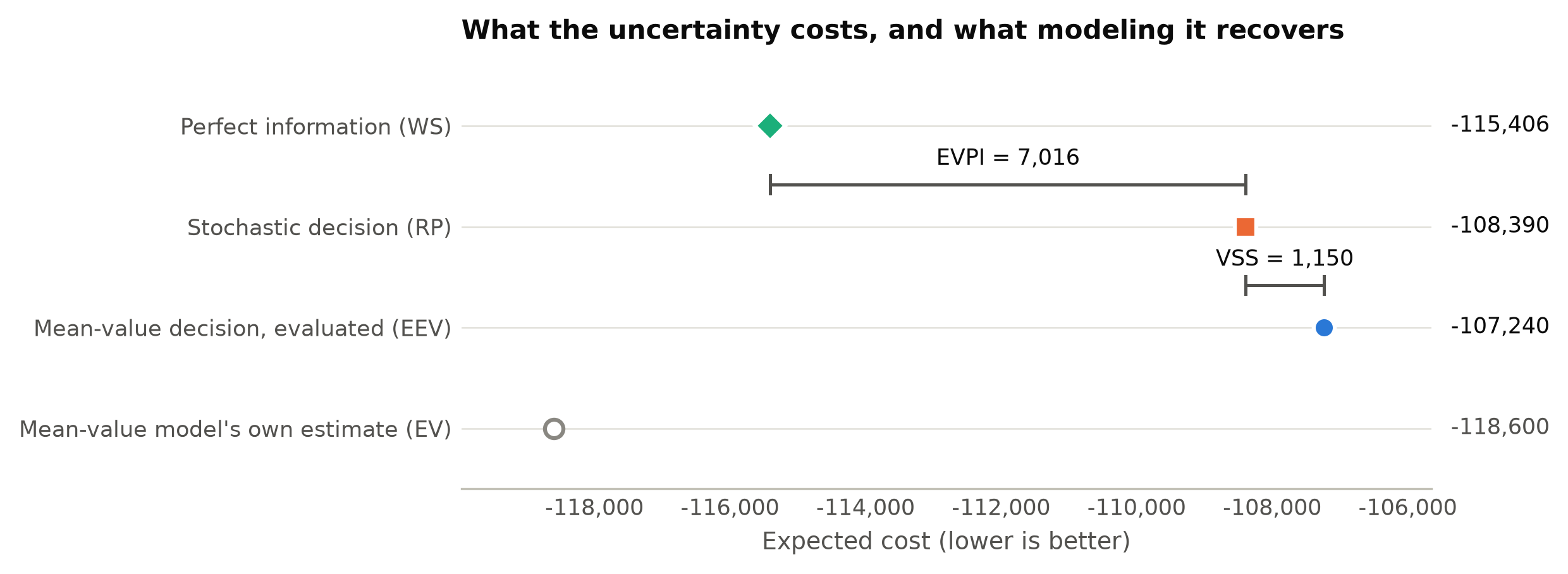
The only requirement
Your model is built by a function of its data:
def build_model(data):      # returns a PuLP, Pyomo, gurobipy, OR-Tools or highspy model
    ...
data is a dictionary of numbers, nested dicts and lists, NumPy arrays, or pandas Series and
DataFrames. StochLift calls the function once per scenario, shares the first-stage variables
across scenarios, and builds the extensive form. It never needs to know where the uncertain
numbers enter the model.
Where to go next
- Getting started: the farmer problem, from the command line and from Python.
- The spec file: every field of
uncertainty.yaml. - Related tools: how StochLift compares with mpi-sppy and others, and when to use them instead.